The Backlash
Many major corporations have withdrawn or scaled back their 2025 Pride initiatives – some by choice, many under pressure, and one that had its participation ruled out by the organizers. What was the reputational impact?
To find out, MAPS analyzed the Pride-related media coverage and social commentary around eleven of the most high-profile of these companies. There are very different reactions to their withdrawals.
This chart shows how much coverage and commentary each brand received, relative to their expected share of voice:

AB InBev and Diageo received very high levels of coverage and commentary following their Pride exits, far exceeding their typical share of voice. Conversely, Target’s share of voice is actually a little lower than we might have expected..
What’s driving these differences? Why is coverage and commentary for some of these brands not what we might expect?
Free Snapshot Report
Want to know how your brand is seen on a specific fast-moving issue? Drop your email here and we’ll set up a quick call to walk you through a free, custom Snapshot.
Six Factors That Predict Backlash
MAPS identified six risk factors that determine whether a brand is more or less likely to face backlash for this type of decision:
- Local Event Impact. Whether the withdrawal fundamentally compromises a specific Pride event’s funding, programming, or viability.
- Sector Risk. How culturally and historically linked the brand’s industry is to LGBTQ+ issues (e.g., alcohol, retail, entertainment = higher risk).
- Timing. When the withdrawal occurred; actions during or near Pride season (i.e., May–June) attract more scrutiny.
- Communication Method. Whether and how withdrawal is communicated, e.g., announcement vs. silence vs. third-party disclosure.
- LGBTQ+ History. The brand’s prior visibility and commitment to LGBTQ+ issues.
- Political Context. How vulnerable the company has been historically to cultural backlash around DEI issues.
Latest MAPS Interviews
- Hear why Fabrice Houdart thinks silence from corporations is the same as complicity when LGBTQ+ equality is at stake.
- Learn why Lisa Hyman believes some corporate missions resonate, and others just disappear into the noise.
- Discover what Matt Skallerud thinks of the corporate response to the current political climate.



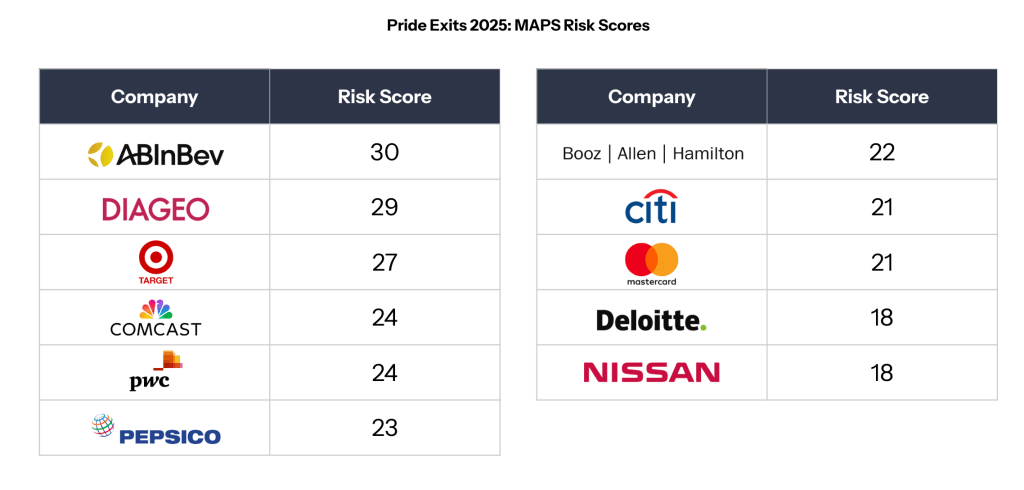
We used the MAPS Risk Index to score each of these companies on each of these six factors. Looking at the total numbers, AB InBev and Diageo are by some distance the most at risk:
How do these scores correlate with the backlash the companies received in media coverage and social media commentary?
Backlash Isn’t Random: How Risk Scores Explain It
There is a very strong correlation – an R² of 0.78 – between a company’s risk score and the extent to which its Pride coverage exceeds expected volume.

Top Insights
- DEI Backlash: Why Some Brands Survive and Others Get Burned
- Why AI Privacy Should Be Every Communications Leader’s Top Priority
- How DEI Communications Can Make or Break a Company’s Reputation

Pride-related backlash isn’t random, or unpredictable. It’s driven by six key factors. When it comes to managing reputational risk, knowing how your organization measures up on a risk index like this is critical to your decision-making and communications.
This applies not just to Pride, but for any issue where cultural expectations are shifting. It helps you think ahead: when to take a stand, how to communicate your decision-making, and indeed how your past actions might shape future reactions. In a fast-moving environment, a simple index like this can be the difference between reacting under pressure…and communicating with purpose.
The MAPS Newsletter
Sign up today for exclusive MAPS insights and interviews like this in your inbox as soon as they’re published.