Corporate DEI in 2025: A Divided Landscape
With the new US administration barely a month old, corporations are facing mounting political, regulatory, and financial pressures around their diversity, equity, and inclusion (DEI) commitments. Major firms including Amazon, Meta, Target and Walmart have announced significant rollbacks and changes to their programs, accelerating a trend we saw starting last year – albeit one driven by conservative activism at the time. On the other side of the equation we see corporations including Apple, Cisco and JPMorgan Chase restating their commitment to DEI.
We’re now starting to see the impact of these positions on consumer spending; last week a headline-grabbing Harris poll showed that 25% of US consumers have stopped shopping at their favorite stores because of their political stances.
What’s the reputational impact of these firms’ decisions? To find out, MAPS looked at mainstream media coverage and social media commentary from July 2024 through mid-February 2025 – over 700,000 articles and mentions in total – focusing on the high-profile companies rolling back their DEI programs, and their counterparts that are recommitting.
Which Companies We Analyzed
We looked at the reputations of firms in two distinct groups:
- ‘Rollback’ companies i.e., those scaling back DEI: Alphabet, Amazon, Citi, Ford, Lowe’s, McDonald’s, Meta, Morgan Stanley, PepsiCo, Target, Walmart, and Walt Disney.
- ‘Defender’ firms, i.e., those reaffirming DEI commitments: Apple, Cisco, Costco, Johnson & Johnson, JPMorgan Chase, and Microsoft.
For the purposes of this analysis, we’ve organized these companies based on a generally accepted view of which group they belong to based on media coverage and social commentary; there are of course nuances here.
Scaling Back DEI Can Seriously Damage Your Reputation
The MAPS analysis showed that the companies scaling back DEI received notably more negative coverage and commentary relative to their total media coverage; 34% of discussion about these companies was negative, compared to 19% negative for companies recommitting to DEI.
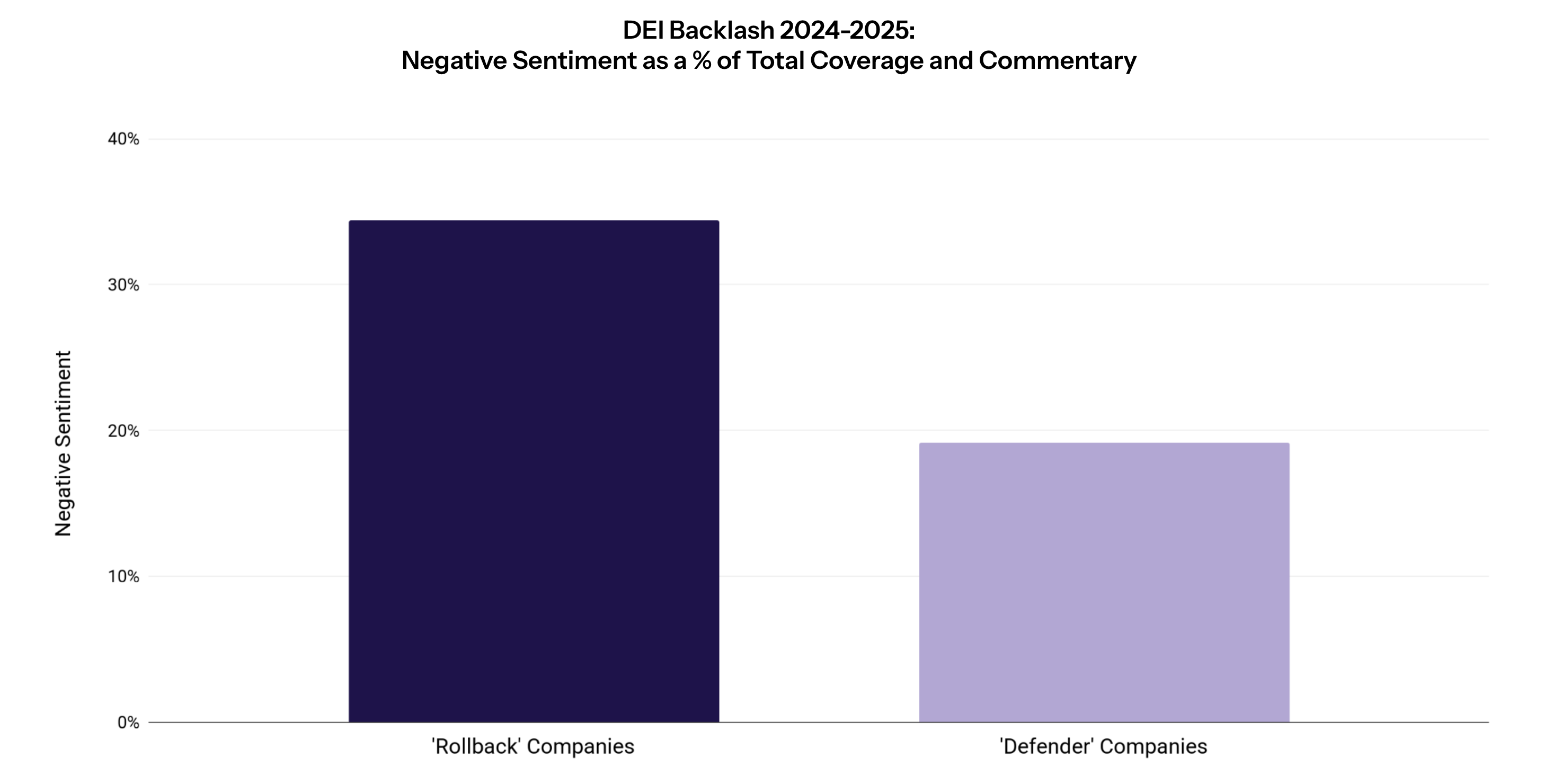
In parallel, companies that scaled back DEI faced not just criticism, but more polarized conversations overall, showing that these firms’ decisions led to intense debate.
Latest MAPS Interviews
- Find out which fitness brand’s customer service and personalization inspired Joe Cashen to create something similar in the automotive industry.
- Discover which podcasts help keep Severine Tarayre up-to-date on everything to do with marketing and consumer behavior. (This is an amazing list, BTW.)
- See why Tyler Simmons thinks marketers should think like salespeople.

Doubling Down on DEI Isn’t a Guaranteed Win
‘Defender’ companies, i.e., those recommitting to DEI programs had fewer negative conversations (19%, as noted above) than the Rollback companies did. However, Defenders didn’t necessarily generate significant positive coverage or commentary either; most conversations about Defenders were neutral in nature, suggesting that recommitting to DEI isn’t automatically praised, but is often just accepted as the norm for these companies.
The Business Context Is Critical
It’s one thing to look at Rollback companies vs. Defender firms at a high level; this gives us a broad picture and starts to hint at some of the considerations at play here. However, it’s important to recognize that not all companies are judged equally when it comes to DEI strategies. Stakeholder expectations – including those of consumers – vary widely based on industry, brand reputation, and how DEI is perceived to align to the company’s values. What might be acceptable or even positively viewed for a company in one sector could provoke backlash in another, and different firms in the same industry will often have different expectations in the consumer’s eyes.
We’re seeing many corporations use a structured scoring framework to help guide their decisions here, weighing considerations including:
- Legal and Regulatory Environment
- Political and Social Climate
- Sector and Business Model
- Workforce Composition
- Investor and Shareholder Influence
- Brand Identity and Corporate Values
- Financial Pressures and Cost Considerations
- Consumer Expectations
- Media and PR Risks
- Global vs. Domestic Operations
Using a decision-making approach like this allows firms to systematically assess the potential risks and opportunities of making decisions around DEI, and can act as a guide to how to communicate decisions and anticipate stakeholder reactions more effectively.
Are All DEI Decisions Judged Equally?
Not all Rollbacks faced equal backlash, and not all Defenders received equal praise. For example, Alphabet scaled back DEI with significantly less backlash than many of its peers, which we can likely attribute to the firm communicating these changes as necessary to comply with recent legal and political shifts, including executive orders and court decisions, rather than a ‘voluntary’ abandonment of its diversity initiatives. In contrast, Target’s abrupt retreat from DEI programs resulted in widespread backlash, negative sentiment, and consumer boycotts including the planned ‘Economic Blackout’ on February 28, 2025 (also aimed at Amazon, Target, and Walmart). We should also note that this isn’t the first time Target has been at the center of controversy around a key element of DEI: LGBTQ+ rights.
Top MAPS Insights
- What does the reaction to Costco and McDonald’s DEI announcements tell us about different generations of stakeholders?
- Which initiatives are moving the needle for the 20 companies with the strongest reputations around LGBTQ+ Rights?
- How does Amazon’s reputation around return to office compare to Microsoft’s among tech-savvy consumers?

Among Defender companies, Cisco stands out by clearly integrating DEI into its strategic narrative – and indeed with CEO Chuck Robbins recognizing the complexity of the issue – while Microsoft’s stance has met with significant negative coverage and commentary.
Up Next: The Role of Communications
Whether a company scales back its DEI efforts or recommits to them, how it communicates that decision determines the level of backlash or support it receives. In the next part of this series, we’ll look at the individual reputation scores for each of these companies, exploring how each of them are framing their DEI messaging, and highlighting what worked (and what didn’t).
From this analysis we’ll identify five key principles to inform your communications strategy – whether you’re making changes to your DEI programs or not.
Contact MAPS today for your free Snapshot
The Snapshot will quantify how you are perceived in comparison to your competition on one of today’s fast-moving issues. This service is limited to just a handful of organizations each week, so leave your details now and we’ll be in touch.