What 2024 Tells Us
As artificial intelligence (AI) becomes more embedded in businesses around the world, there’s an increasing focus in mainstream and social media on how corporations can and should be using AI responsibly.
What does this mean for communications leaders, and how should they think about talking about how their organizations are using AI? What happens if we ‘double-click’ on responsible AI to see what people actually care about?
MAPS looked at data from the second half of 2024 to find out…
The Biggest Concern: Privacy and Data Protection
Privacy and data protection emerged as the most discussed area in the responsible AI space, with nearly 1.4 million mentions – almost double the volume of the next highest topic.
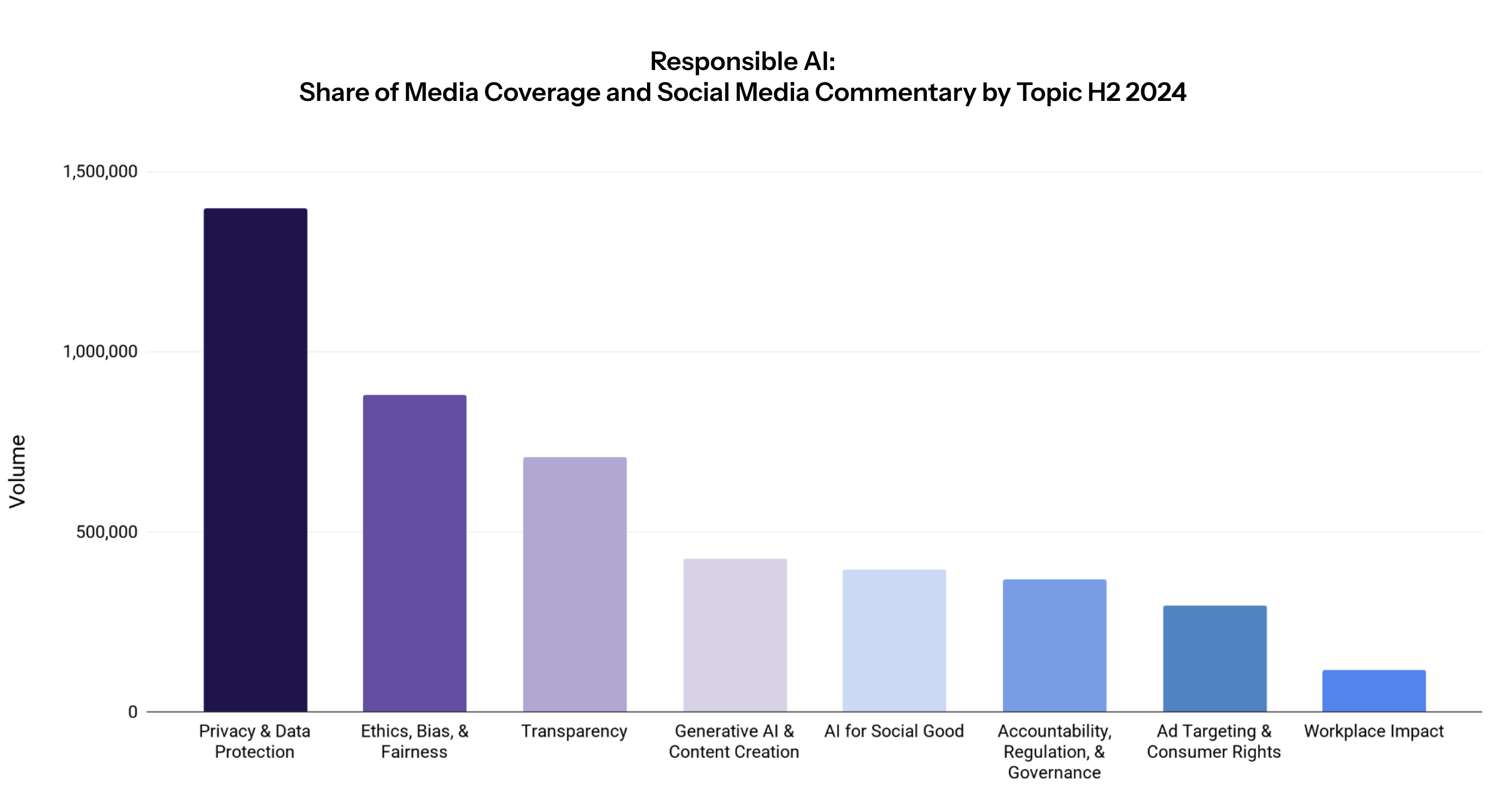
Coverage and commentary grew in November and December, driven by regulatory developments and high-profile data breaches, with consumers, regulators and other stakeholder groups demanding better protections as AI-powered tools collect and process huge amounts of personal data. For example:
- The privacy activist group None Of Your Business filed a complaint against X regarding an apparent change to its data settings, allowing the company to use public posts to train the Grok AI platform.
- Meta was in the news further to a ‘copypasta’ being widely shared on Facebook; the text – in vain – was designed to block Meta from harvesting user data for training AI models.
- News reports in July 2024 focused on the 2023 hacking of OpenAI’s messaging systems.
Takeaway: Privacy isn’t just about compliance, and is now central to brand trust. Corporations that proactively communicate specifics around how they protect user data – e.g., through user control and risk management – will define the industry standard, and run less risk of having to react to regulatory crackdowns.
Watchout: Avoid privacy theater. Announcing new privacy initiatives without making substantive changes can backfire, and stakeholder groups are growing more skeptical of vague claims.
Free Snapshot Report
Want to know how your brand is seen on a specific fast-moving issue? Drop your email here and we’ll set up a quick call to walk you through a free, custom Snapshot.
The Ethical Imperative: Bias and Fairness
Ethics, bias, and fairness make up almost 20% of media coverage and social media commentary. As more organizations adopt AI across their operations, different stakeholder groups – and also some of the firms developing AI systems – are raising concerns about biased algorithms and unfair outcomes in areas such as recruitment, lending, and law enforcement. For example:
- In September 2024, researchers published a study indicating that “cultural prompting” – essentially, asking an AI model to perform a task like someone from another part of the world – resulted in reduced bias in responses. They found that without this prompting, LLMs tended to reflect values from English-speaking and Protestant European countries.
- In October 2024, leaders from the House Financial Services Committee introduced measures designed to mitigate bias and discrimination in AI-powered financial services.
- Microsoft was in the news around its FATE program (Fairness, Accountability, Transparency, and Ethics in AI), which is focused on the societal implications of AI. [Is it just me or would FEAT be a little less ominous-sounding?]
Takeaway: Companies that fail to address AI bias risk compromising existing diversity, equity, and inclusion (DEI) efforts – though of course it remains to be seen how long this rubric holds – and losing customer trust. One suggestion for communications leaders is to frame fairness as a business-critical issue, not just a regulatory or ethical one, with audits and public accountability reports on bias mitigation one way to differentiate a company’s approach here.
Watchout: Don’t assume AI bias can be fully “fixed.” Bias mitigation is an ongoing process, not a one-time audit, and communications leads should be clear that AI fairness initiatives are evolving.
Top MAPS Insights
- What does the reaction to Costco and McDonald’s DEI announcements tell us about different generations of stakeholders?
- Which initiatives are moving the needle for the 20 companies with the strongest reputations around LGBTQ+ Rights?
- How does Amazon’s reputation around return to office compare to Microsoft’s among tech-savvy consumers?

The Foundation of Trust: Transparency
Transparency was the third most-discussed topic, with over 700,000 mentions. It’s worth noting that there was a significant increase in discussions in December 2024, reflecting a growing demand from consumers, regulators, and other stakeholder groups for visibility into how AI systems make decisions. For example:
- In November, the EU published the draft of its new AI transparency guidelines, requiring companies to disclose how their algorithms influence high-stakes decisions, such as hiring and credit scoring.
- In October 2024, the Federal Trade Commission (FTC) issued warnings to companies engaging in “AI washing,” where businesses falsely claim their products are AI-powered to attract customers.
- California Governor Gavin Newsom signed the California AI Transparency Act into law in September 2024.
Takeaway: Transparency is now a business necessity, not a nice-to-have. Consumers, regulators and other stakeholder groups are demanding more visibility into decisions powered by AI, and the companies that lead in transparency will win long-term trust. As with bias mitigation, being upfront about limitations, data sources, and risks can enhance credibility rather than weaken it.
Latest MAPS Interviews
- Find out which fitness brand’s customer service and personalization inspired Joe Cashen to create something similar in the automotive industry.
- Discover which podcasts help keep Severine Tarayre up-to-date on everything to do with marketing and consumer behavior. (This is an amazing list, BTW.)
- See why Tyler Simmons thinks marketers should think like salespeople.

Watchout: Over-disclosure can be as damaging as under-disclosure. Dumping technical documentation on consumers or regulators without context might in fact cause confusion, or create new liabilities, and corporations need to keep in mind the fact that they’re speaking to different audiences with different expectations here.
Other Key Issues: Generative AI, Regulation, Social Good, and Workplace Impact
While privacy, ethics, and transparency led the discussion, several other topics are shaping the responsible AI landscape:
- Generative AI in the context of content creation remained a hot-button issue, particularly in creative and media industries.
- In terms of governance and regulation, the United Nations held a summit on AI ethics in October, calling for stronger global oversight and accountability frameworks.
- In the context of social good, in September Google DeepMind announced protein modeling breakthroughs that could accelerate drug discovery. Also in the second half of 2024, NGOs – including the UN and Climate Change AI – partnered with AI developers to improve climate modeling and natural disaster response strategies.
- Workplace impact was in the news – and was a topic of discussion in social – as automation continues to reshape industries; one example is discussion of Amazon’s deployment of autonomous robots such as Proteus in fulfillment centers.
Up Next
The AI landscape is quickly moving from excitement to accountability, and responsible AI conversations are evolving accordingly. While privacy, ethics and transparency remain top priorities, topics like generative AI regulation and workplace impact are gaining traction.
In a subsequent post we’ll look at which responsible AI topics are growing most quickly, and what that means for communications leaders looking to stay ahead of the curve. Stay tuned.