From Two Wheels to Four Wheels
Last week, MAPS explored the online reaction to Harley-Davidson ending its Diversity, Equity, and Inclusion (DEI) initiatives. Our analysis examined how this differed by age and political affiliation and what the implications might be from a marketing and reputation standpoint. Days later, Ford revealed a shift in its DEI efforts, signaling three key changes in its approach:
- No longer participating in the Human Rights Campaign’s Corporate Equality Index or any other external ‘culture’ assessments.
- Refocusing employee resource groups (ERGs) to be open to all employees, rather than specific demographics. (Presumably this means the end for the Ford Pride ERG.)
- Eliminating quotas for minority dealerships and suppliers.
Latest MAPS Interviews
- Discover who David Oliver worked with to prevent his Russian colleagues from being arrested.
- Learn what Marlena Sarunac thinks the key is to ensuring your brand rises above the noise.
- Find out which fitness brand’s customer service and personalization inspired Joe Cashen to create something similar in the automotive industry.

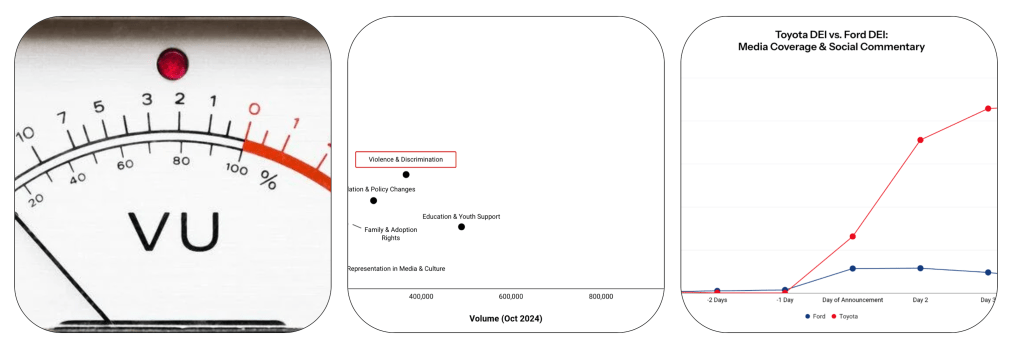
We’ve analyzed the data behind both stories and identified major differences in the online reaction, and how this might affect the firms’ reputations around DEI. First, the disparity in the level of public engagement between these two corporations is striking. The day after the announcement was the biggest for both brands, but the Harley-Davidson announcement generated almost five times (!) as much content as Ford’s news:

Why is this? There are several potential factors.
Contact MAPS today for your free Snapshot
The Snapshot will quantify how you are perceived in comparison to your competition on one of today’s fast-moving issues. This service is limited to just a handful of organizations each week, so leave your details now and we’ll be in touch.
Brand Identity and Customer Base
Harley-Davidson’s customer base is likely more politically conservative and homogenous than Ford’s; the alignment between the corporation’s decision and its core audience appears to have led to more enthusiastic reactions and discussions online. Ford, on the other hand, has a broader and more diverse customer base.
Timing and Approach
Harley-Davidson’s DEI shutdown was more abrupt – arguably the highest-profile such announcement this year – and the announcement was more definitive. Ford’s approach was arguably more nuanced, with the company framing its changes as a “reassessment” of its DEI strategies rather than a complete shutdown. This ostensibly less dramatic approach may have resulted in fewer reactions on social media. Just as importantly, Harley-Davidson made the announcement on social media; Ford’s changes were signaled via an internal email that was subsequently confirmed as authentic.
Top Insights
- Which initiatives are moving the needle for the 20 companies with the strongest reputations around LGBTQ+ Rights?
- How does Amazon’s reputation around return to office compare to Microsoft’s among tech-savvy consumers?
- Is discussion of Harley-Davidson’s and Ford’s DEI changes taking place in the same places online – and why does this matter?
Activist Involvement
The involvement of conservative activist Robby Starbuck played a role in both cases. However, Harley-Davidson’s decision seemed to be a more direct response to this pressure, which could have amplified the social media response. In Ford’s case, Starbuck mentioned that they were “in the middle of investigating” Ford’s policies when the company announced changes. This suggests a less direct confrontation, potentially leading to a more muted social media reaction.
Next time around we’ll see whether there are any differences in the source of online commentary and coverage for the two corporations; does it come predominantly from social media, or from mainstream media, and what are the implications for the reputations of the two firms?
Next Steps
Contact us today for your free MAPS Snapshot, quantifying how you are perceived in comparison to your competition on LGBTQ+ Rights.