Hitting the Brakes
On August 20, in the face of mounting conservative activism, Harley-Davidson announced an end to its Diversity, Equity, and Inclusion (DEI) efforts: “[W]e have not operated a DEI function since April 2024, and we do not have a DEI function today. We do not have hiring quotas and we no longer have supplier diversity spend goals.” The announcement led to a significant increase of media coverage and social media commentary focused on the corporation and its DEI efforts – rising from a negligible level to over 10,000 articles and comments on the day of the announcement.
Latest MAPS Interviews
- Learn why bricks and mortar are still important for Cenk Bulbul.
- Which brand’s approach to marketing and communications still inspires Orli LeWinter?
- Find out what pushed Alex Kantrowitz to make a career pivot and to start Big Technology.

One major issue for organizations as they develop their corporate and communications strategies around DEI and other fast-moving issues is alignment with marketing: specifically, whether the organization’s efforts around these issues will polarize and/or galvanize opinion among their target audiences, and ultimately affect their ability to connect with consumers. The recent examples of Target and Bud Light demonstrate the challenges for brands if these efforts aren’t aligned.
A Generational Divide
What can we discover about the online reaction to Harley-Davidson’s announcement that gives us an insight into how their leadership will be thinking about this going forward? Let’s look at how the reaction varied across different age cohorts.
Contact MAPS today for your free Snapshot
The Snapshot will quantify how you are perceived in comparison to your competition on one of today’s fast-moving issues. This service is limited to just a handful of organizations each week, so leave your details now and we’ll be in touch.
Baby Boomers – Harley-Davidson’s traditional customer base – were the most engaged, driving almost 50% of the online activity. This suggests that the decision resonated strongly with the company’s core audience, a critical data point for any brand considering a pivot in its public stance.
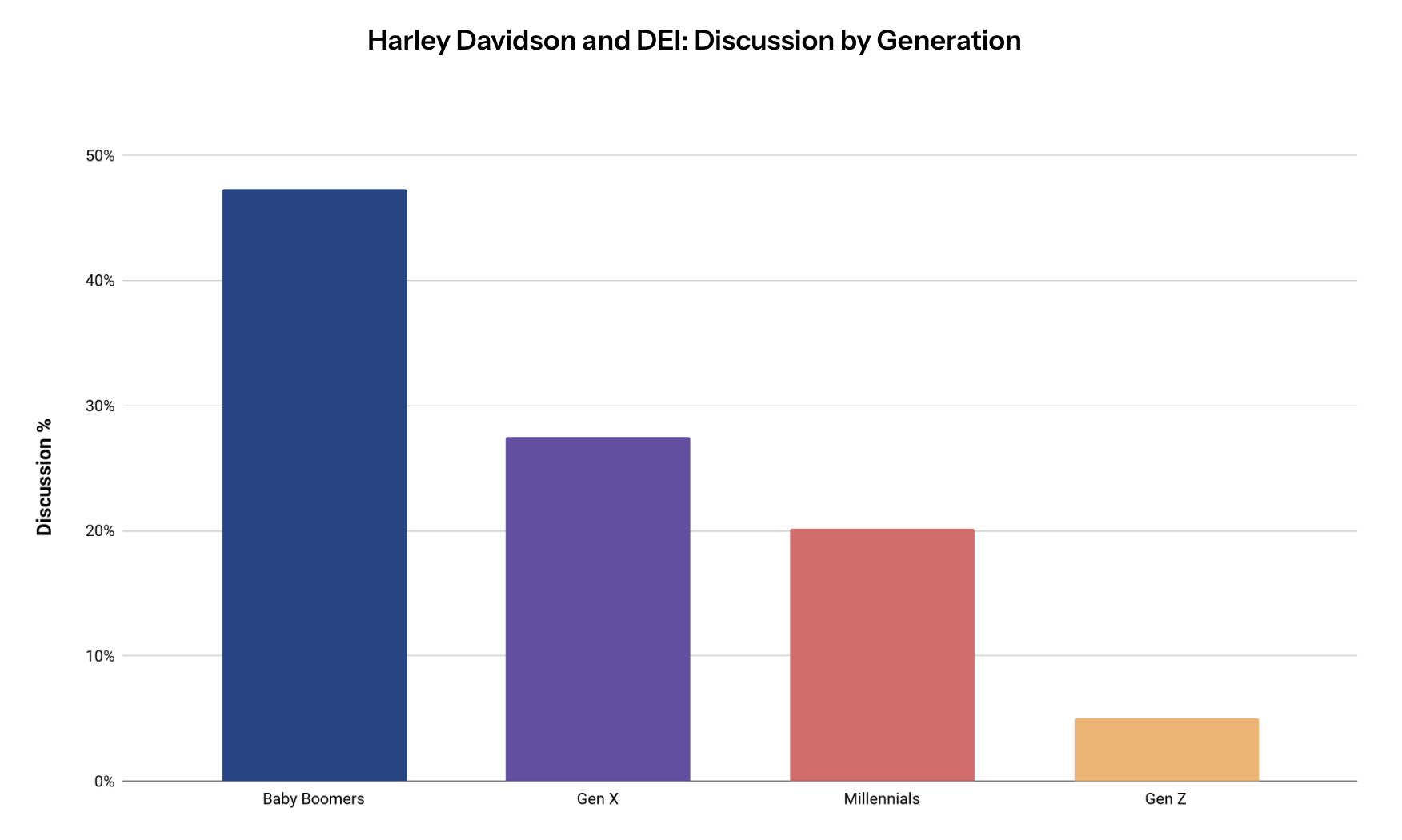
However, the data also reveals a potential vulnerability. Gen X and Millennials accounted for 27% and 20% of the conversation, respectively, but Gen Z, the most progressive generation, made up only 5% of the social activity. This lack of engagement from Gen Z could signal a disconnect between Harley-Davidson and the future consumers and workforce it needs to attract. In a world where brand loyalty is increasingly built on shared values, this may not be a gap Harley-Davidson can afford to ignore.
Top Insights
- Which initiatives are moving the needle for the 20 companies with the strongest reputations around LGBTQ+ Rights?
- How does Amazon’s reputation around return to office compare to Microsoft’s among tech-savvy consumers?
- Is discussion of Harley-Davidson’s and Ford’s DEI changes taking place in the same places online – and why does this matter?
Next time we’ll look at how the announcement was received by consumers on both sides of the aisle. Will Harley-Davidson ride into the future, or is it in danger of being left behind?
Next Steps
Contact us today for your free MAPS Snapshot, quantifying how you are perceived in comparison to your competition on LGBTQ+ Rights.