2024 Activism -> 2025 Administration
We’ve recently seen a big uptick in companies scaling back their DEI efforts. In 2024, this appeared to be in response to social media-driven conservative activism, while this year we can more likely attribute these changes to a desire to in some way mirror the priorities of the new administration.
These changes have come from some niche industry firms but also major enterprises including Walmart, Ford, Toyota, Harley-Davidson and more recently, Amazon and Meta. MAPS is producing a ton of analysis on which companies are navigating this area successfully from a reputational standpoint, and we’re sharing an excerpt here focused on Costco and McDonald’s.
This sheds light on just one element of the decision-making process around communications – and indeed the underlying programs – focused on LGBTQ+ Rights, namely how different generations are engaged by, and perceive the actions of the two companies.These nuances point to potential reputational risks and opportunities with each audience. We’re going to focus on the overall numbers first, and go into more detail on perceptions in a subsequent post.

Costco vs. McDonald’s
In December, Costco’s board rejected a proposal put to it by the National Center for Public Policy Research (NCPPR) requesting an investigation and potential elimination of its DEI efforts. The board stated that Costco’s “efforts at diversity, equity and inclusion remind and reinforce with everyone…the importance of creating opportunities for all,” noting that these efforts are important for attracting employees, improving store services, and driving creativity and innovation.
In contrast to Costco, in January 2025 McDonald’s announced it would roll back some of its DEI practices, citing the “shifting legal landscape” following the 2023 Supreme Court ruling on affirmative action – the same ruling that the NCPPR cited in its statement to Costco’s board. What this means is that McDonald’s will no longer set “aspirational representation goals,” will end its supplier DEI pledge requirement, suspend participation in external surveys (presumably including the Human Right Campaign’s Corporate Equality Index), and rename its diversity team as a “Global Inclusion Team.”
Latest MAPS Interviews
- Discover who David Oliver worked with to prevent his Russian colleagues from being arrested.
- Learn what Marlena Sarunac thinks the key is to ensuring your brand rises above the noise.
- Find out which fitness brand’s customer service and personalization inspired Joe Cashen to create something similar in the automotive industry.

The Generation Gap
How much do different generations care about what these companies are doing, and what might this mean from a communications perspective, given what we know about what motivates these different audiences?
- Baby Boomers
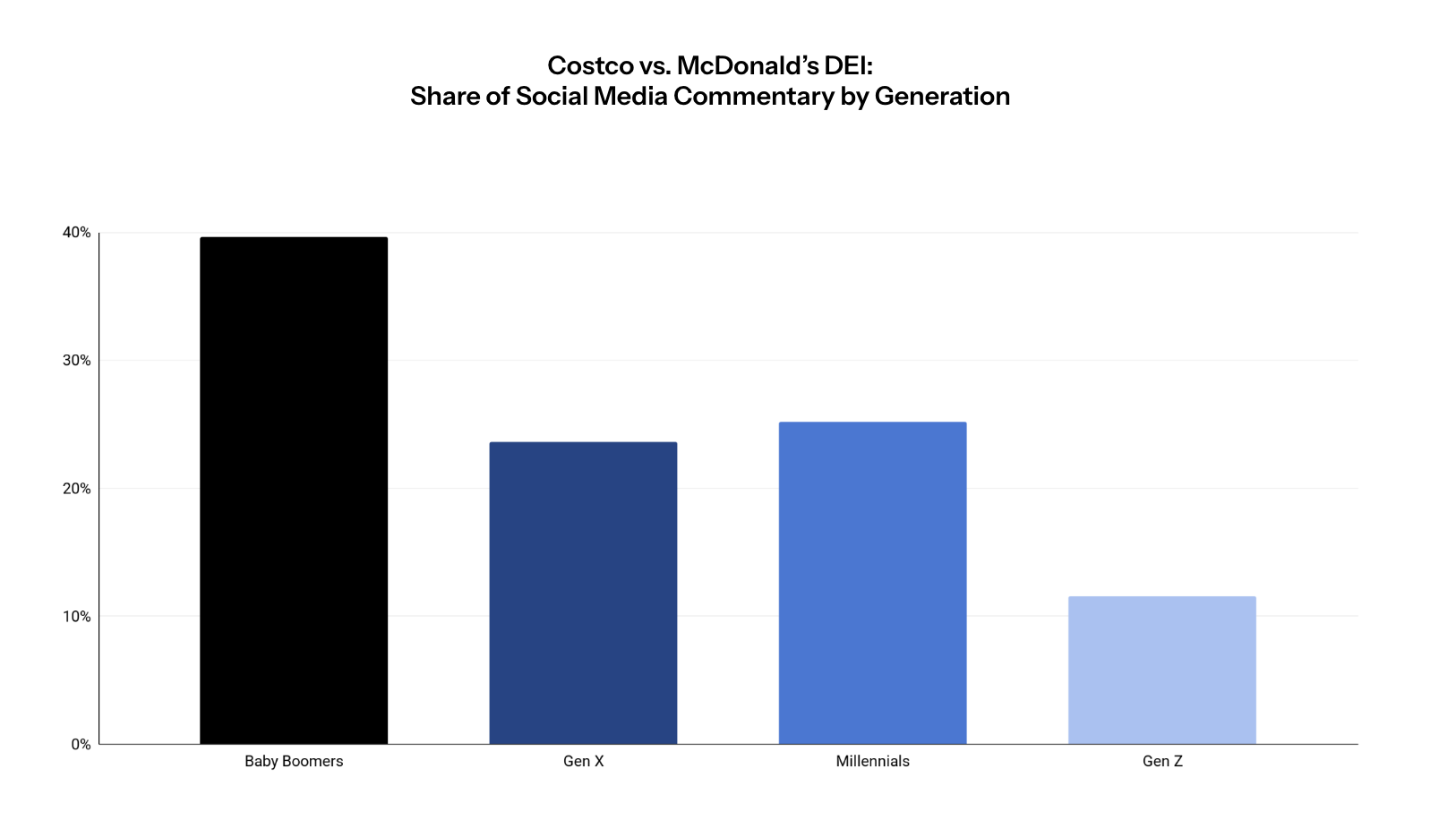
- Baby Boomers are the most engaged generation, accounting for the largest share of posts in social media.
- Their focus may well come from an interest in broader corporate accountability and the reputational stakes of high-profile decisions, and suggests that DEI efforts – and indeed changes to DEI programs – should be framed to appeal to this segment’s preference for results-oriented narratives.
- Gen X
- Gen X engagement is much lower than that of Baby Boomers, and represents just less than a quarter of all posts about the two companies’ initiatives.
- As a generation focused on workplace fairness, their engagement – or otherwise – may reflect how DEI changes are framed as impacting employee equity and inclusion.
- Millennials
- Millennials are the second-most engaged group, accounting for 25% of all mentions in social media.
- The opportunity here is surely to connect with Millennials – known for their values-driven consumer behavior – by emphasizing authenticity and how the company’s actions align with society’s needs and personal values.
- Gen Z
- Gen Z’s relatively low engagement signals either (1) a disinterest in what either company is doing around DEI or (2) skepticism about the sincerity of any approach.
- There is a huge opportunity for communications teams to engage with this audience: understanding their perspectives around what priorities should be and communicating them in a way that resonates.
It’s worth noting that for most of the analyses MAPS produces, the general rule of thumb is that younger = more social commentary. This discussion turns that dynamic on its head.
Top MAPS Insights
- Which initiatives are moving the needle for the 20 companies with the strongest reputations around LGBTQ+ Rights?
- How does Amazon’s reputation around return to office compare to Microsoft’s among tech-savvy consumers?
- Is discussion of Harley-Davidson’s and Ford’s DEI changes taking place in the same places online – and why does this matter?
Up Next
DEI decisions are under the microscope right now, and communications leaders need to have a solid understanding of how different audiences will react. Some corporations are making big, public commitments to inclusion, and others are retreating and scaling back programs. The way these moves are communicated may be just as important from a reputational standpoint as the decisions themselves. Who’s paying attention? Which messages will resonate and with whom?
In a following post we’ll look at how the different generations actually perceive the actions of Costco and McDonald’s. I was quite surprised at how the data look – and you might be too…
Contact MAPS today for your free Snapshot
The Snapshot will quantify how you are perceived in comparison to your competition on one of today’s fast-moving issues. This service is limited to just a handful of organizations each week, so leave your details now and we’ll be in touch.
Next Steps
- Contact us today for your free MAPS Snapshot, quantifying how you are perceived in comparison to your competition on LGBTQ+ Rights.